Let's go to the "bazar Ramadan": a Malay dialogue lesson
Mahsuri wants to introduce "bazar Ramadan" to her friend, Ryu. Read and learn key words and phrases for inviting a friend to go out.


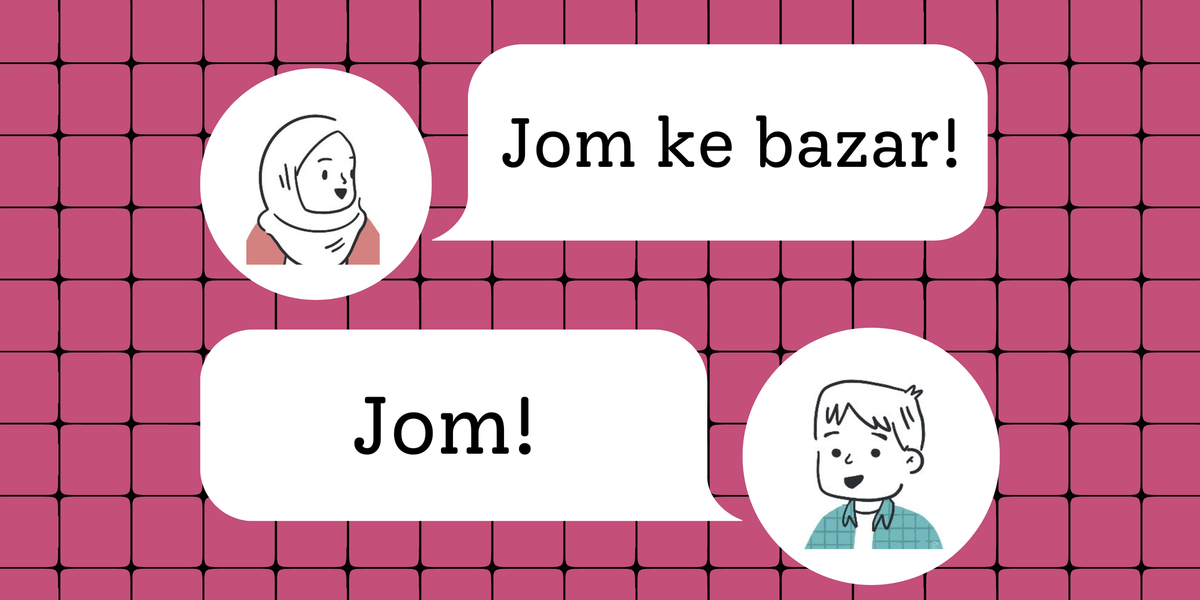
Read the following dialogue between two friends, Mahsuri and Ryu. Mahsuri calls Ryu and they make a plan to go to a bazaar. There are two versions of the dialogue: standard Malay and casual Malay.
Standard Malay conversation
Let's start with the standard Malay conversation. ⬇️ The tone of this conversation is formal and it uses standard Malay grammar.

1. Standard Malay ⤵️
🧕🏻Mahsuri: Helo, Ryu! 😎 Apa khabar? (Hello, Ryu! How are you?)
🙋🏻♂️Ryu: Hai, Mahsuri. Khabar baik! 🥳 (Hi, Mahsuri. I'm good.) Awak pula? (What about you?)
🧕🏻Mahsuri: Saya baik-baik saja. (I'm doing good.) Sudah lama kita tidak berjumpa. (Long time no see.) Sekarang bulan puasa, jadi saya terfikir mungkin kita boleh pergi ke bazar Ramadan bersama-sama. (It's the fasting month now, so I was thinking we could go to a Ramadhan bazaar together.)
🙋🏻♂️ Ryu: Saya tidak pernah ke bazar Ramadan. (I've never been to a Ramadhan bazaar.) Tahun ini juga tahun pertama saya cuba-cuba untuk berpuasa. (I'm also trying to fast for the first time this year.)
🧕🏻Mahsuri: Wah, bagusnya awak, Ryu! (Wow, you're amazing, Ryu!) Kalau begitu, saya mahu cadangkan bazar Ramadan berdekatan perumahan saya. (Then, I recommend the Ramadhan bazaar near my house.) Ada pelbagai jenis makanan yang dijual di sana. (There is a variety of food being sold there.)
🙋🏻♂️ Ryu: Saya pun memang sudah lama ingin mencuba beberapa hidangan Ramadan yang terkenal seperti martabak, apam balik dan onde-onde. (I've also been wanting to try some popular Ramadhan dishes like martabak, apam balik, and onde-onde.)
🧕🏻Mahsuri: Awak pasti suka semua makanan itu. (You'll surely like all of them.) Saya ada masa lapang pada pukul 5 petang hari Selasa ini. (I'm free at 5PM this Tuesday.) Awak pula bagaimana? (What about you?)
🙋🏻♂️ Ryu: Hari Selasa boleh! (Tuesday is good!) Jumpa nanti ya, Mahsuri! (See you then, Mahsuri!)
🧕🏻Mahsuri: Baiklah. Jumpa hari Selasa nanti, Ryu! (Alright. See you on Tuesday, Ryu!)
🔼 Important vocabulary and phrases 🔼
- Saya terfikir = I was thinking
- ingin mencuba = want to try
- berdekatan kawasan perumahan = near a housing area
- pelbagai jenis = various types
- lapang = free, open
Casual Malay conversation
The next conversation has the same meaning as the previous conversation but this one uses an informal tone and does not follow standard Malay grammar. This is what you will hear when people in Kuala Lumpur and Selangor speak in Malay, and the accent sounds similar to the accent of speakers from Pahang and Johor.
Note that the italicised words are shortened forms of words or slangs.

2. Casual Malay ⤵️
Mahsuri = 🧕🏻
Ryu = 🙋🏻♂️
🧕🏻: Helo, Ryu! Apa khabar? Sihat ke?
🙋🏻♂️: Hai, Mahsuri. Saya sihat je! Awak sihat tak?
🧕🏻: Saya pun sihat. Dah lama kita tak jumpa. Sekarang kan bulan puasa, jomlah pergi bazar Ramadan sama-sama.
🙋🏻♂️: Tak pernah pulak saya pergi bazar Ramadan. Saya baru cuba puasa tahun ini.
🧕🏻: Bagusnya!😃 Kalau camtu, kita pergi bazar Ramadan dekat rumah saya. Kat situ ada banyak makanan, tau tak.
🙋🏻♂️: Dah lama saya nak makan makanan bazar cam martabak, apam balik ngan onde-onde.
🧕🏻: Awak mesti suka punya. Kalau Selasa pukul lima boleh tak?
🙋🏻♂️: Boleh sangat! Kita jumpa nanti eh?
🧕🏻: OK. Jumpa hari Selasa nanti.
🔼 Important vocabulary and phrases for casual Malay 🔼
- je: shortened form of "sahaja" and "saja" (only/just)
- Saya sihat je: literally "I am just healthy." It means "I'm healthy and doing fine." 👨🏽🦳
- pulak: casual pronunciation of the word "pula". "Pula" is used for emphasis and comparison. ❗It can mean "ever", "more", "even", or "whereas".
- Tak pernah pulak: "I have never ever..." 🤔
- tau: shortened form of "tahu" (to know)
- ngan: shortened form of "dengan" (with). Sometimes it replaces "dan" (and) in casual conversation.
- boleh sangat!: literally "very possible!" Say this when you want to agree enthusiastically 🥳 with a plan.
- eh: we say this to mean "okay?" or "alright?" 😃 at the end of a sentence for confirmation. We could also say this to show disbelief when hearing something shocking. It is similar to "Really?" 🤯
Now, to test your Malay skills you can pick one phrase and say it around a Malay speaker. Come back and tell us about their reaction in the comments below. 👩🏫
Read the next article in this series ➡️